Life brings different experiences to everyone. Some people seem comfortable expressing themselves, while others need time to discover their strengths. Some feel clear about their career goals from an early age, while others go through several changes before finding the right direction. Relationships, family expectations, financial responsibilities, and personal dreams can also influence how we see ourselves.
When these questions arise, many people become curious about astrology and what their birth chart might reveal. Vedic astrology offers a traditional way to explore personality, life patterns, relationships, and personal growth through the positions of planets and the twelve houses.
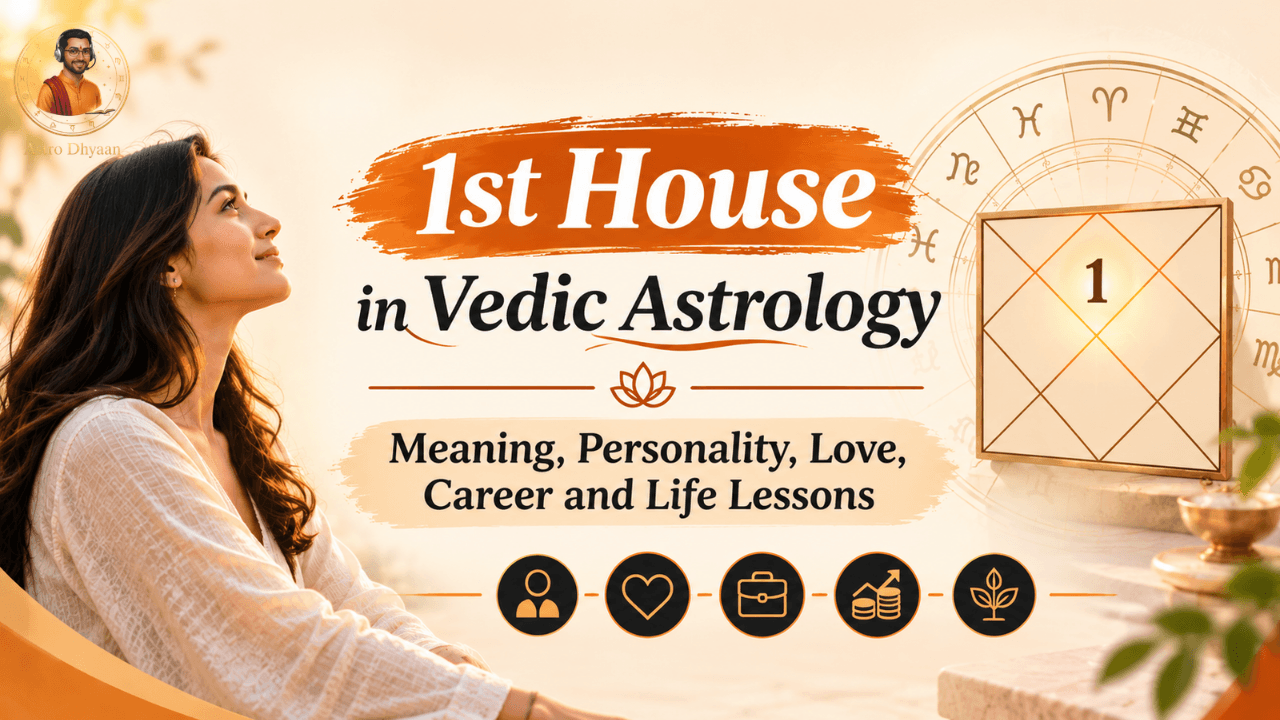
Among these houses, the 1st House in Vedic Astrology holds particular importance because it represents the individual. It is associated with the ascendant, commonly known as Lagna, which provides the starting point for interpreting a Vedic horoscope.
Learning about this house can help you understand how astrologers traditionally interpret confidence, personal identity, love, marriage, career, and other aspects of life. It can also encourage you to reflect on your strengths and the areas where you would like to grow.
In this guide, we will explore its meaning, planetary influences, relationship connections, career considerations, and the role of a kundli in understanding life's important questions.
What Is the First House in Vedic Astrology?
In Vedic astrology, the first house is known as the Lagna Bhava. It represents the self and is traditionally associated with personality, physical appearance, temperament, confidence, and the way a person approaches the world.
The zodiac sign rising on the eastern horizon at the time of your birth is called your ascendant or Lagna. To calculate it accurately, astrologers generally need your date of birth, exact birth time, and birthplace.
The ascendant is important because it establishes the arrangement of the twelve houses in a Vedic birth chart. Each house represents different areas of life, including family, money, education, relationships, career, and spiritual development.
For example, two people may have similar educational backgrounds but very different approaches to their professional lives. One may enjoy taking the lead, while the other may prefer careful planning and working independently. Their upbringing, experiences, and individual preferences all contribute to these differences.
An astrologer may use the ascendant and other chart placements to offer a traditional interpretation of personality. However, astrology is not a scientifically established method for determining someone's character or predicting their future.
Your birth chart should not be treated as a fixed description of who you must become. Instead, it can serve as a starting point for self-reflection if astrology is meaningful to you.
Why Is the Ascendant Important in a Kundli?
Your ascendant is one of the first factors astrologers examine when preparing a Vedic horoscope. It determines the zodiac sign associated with each house and helps establish how planetary placements are interpreted.
The first house is traditionally connected with the self, while the other houses provide information about different life themes.
For instance, the second house is associated with accumulated wealth and family resources. The seventh house relates to partnerships and marriage, while the tenth house represents career, responsibilities, and public reputation.
The ascendant helps astrologers connect these subjects within the larger chart.
Imagine someone who has been working in the same position for several years. Their salary is reasonable, but they feel that their professional life has stopped moving forward. They may be considering a career change but are worried about losing financial stability.
A traditional astrology consultation might examine the ascendant, tenth house, planetary placements, and relevant planetary periods. This can provide an astrological perspective, but the person should also evaluate their skills, finances, experience, and available job opportunities.
Similarly, someone experiencing relationship difficulties may use a horoscope reading as an opportunity to reflect on emotional needs and expectations.
The important point is that a kundli does not make decisions for you. Your circumstances, efforts, and choices remain central to the direction your life takes.
How Planets in the First House Influence Its Interpretation
In Vedic astrology, a planet placed in the ascendant house is traditionally considered significant. Its interpretation depends on several factors, including the ascendant sign, planetary condition, aspects, conjunctions, and the rest of the horoscope.
There is no single planetary placement that should automatically be considered good or bad.
Sun in the First House
The Sun represents identity, authority, leadership, and self-expression in traditional astrology.
When the Sun occupies the ascendant, astrologers may associate it with independence, ambition, and a strong desire to establish one's identity.
These themes may encourage reflection on confidence and responsibility. However, confidence does not mean always being right or needing to control every situation.
In professional life, listening to feedback and accepting mistakes can strengthen leadership. In personal relationships, respecting another person's perspective can help maintain a healthy balance between independence and understanding.
Moon in the First House
The Moon is associated with the mind, emotions, comfort, and emotional responses.
Its placement in the first house is traditionally linked with sensitivity, adaptability, and awareness of the surrounding environment.
Someone who relates to these themes may be particularly attentive to other people's feelings. At times, however, they may spend too much time thinking about a conversation or worrying about how others perceive them.
If this sounds familiar, practical habits such as journaling, taking breaks, and communicating openly can help you understand your feelings more clearly.
Emotional sensitivity is not a weakness. Learning to manage emotions and maintain boundaries can help you build healthier relationships.
Mars in the First House
Mars represents energy, courage, initiative, and determination.
Its placement in the first house is often interpreted as a sign of an active, competitive, or direct temperament.
This symbolism may relate to someone who enjoys challenges and prefers taking action rather than waiting for opportunities. However, impatience or impulsive reactions can sometimes create unnecessary conflict.
Consider a disagreement with a colleague. Responding immediately while feeling angry might make the situation worse. Taking time to understand the problem before replying can lead to a more constructive conversation.
The practical lesson is to channel energy into productive activities and develop the ability to respond thoughtfully under pressure.
Mercury in the First House
Mercury is associated with communication, reasoning, curiosity, and learning.
Traditional interpretations may connect this placement with an interest in writing, speaking, business, education, and problem-solving.
Strong communication skills can be useful in many professional environments, but they also matter in personal relationships. Being able to explain your expectations clearly can prevent misunderstandings.
At the same time, overthinking can make even simple decisions feel difficult. Gathering relevant information, considering the available options, and choosing a reasonable next step can help you move forward.
Jupiter in the First House
Jupiter represents wisdom, learning, growth, and guidance.
Its placement in the ascendant is traditionally associated with optimism, generosity, and an interest in gaining knowledge.
These themes can encourage a person to value education, ethical behaviour, and long-term thinking.
However, positive thinking alone cannot solve every problem. Career growth requires skills and effort, while financial stability often depends on planning and responsible decisions.
A balanced approach combines hope with realistic expectations and consistent action.
Venus in the First House
Venus is associated with beauty, affection, harmony, creativity, and relationships.
When placed in the ascendant, it is traditionally interpreted as an indication of charm, artistic interests, or a desire for harmonious connections.
In love, these themes may encourage a person to value emotional closeness and mutual understanding.
However, a healthy relationship does not require you to agree with your partner about everything. Respectful disagreements, honest communication, and clear boundaries are also important.
Remember that your self-worth should not depend entirely on your appearance or another person's approval.
Saturn in the First House
Saturn symbolizes discipline, patience, responsibility, and structure.
Its placement in the ascendant is traditionally associated with seriousness, perseverance, and gradual development.
Some people may relate to this symbolism when they feel that their goals are taking longer to achieve than expected. They might compare their progress with friends who appear to be moving ahead more quickly.
But life does not follow the same timeline for everyone. Career changes, financial responsibilities, family circumstances, and personal priorities can all influence the pace of progress.
Instead of treating delays as permanent failure, focus on building useful skills, maintaining consistent habits, and measuring your progress against your own goals.
Rahu and Ketu in the First House
Rahu and Ketu are the lunar nodes used in Vedic astrology. Traditional interpretations associate them with desire, detachment, identity, and personal development.
Rahu in the ascendant may be interpreted as a strong desire for recognition or a distinct personal identity. Ketu in this position may be associated with introspection, detachment, or a search for deeper meaning.
These are symbolic interpretations, not fixed outcomes. Neither placement automatically indicates that someone will experience success, loneliness, confusion, or difficulty.
A complete reading considers the wider chart, and real-life experiences depend on many factors beyond astrology.
What Does the First House Mean for Love and Relationships?
Relationships can influence almost every part of our lives. When things are going well, we may feel supported and confident. When misunderstandings become frequent, even ordinary daily responsibilities can begin to feel stressful.
Sometimes, relationship difficulties arise because two people have different expectations. One partner may prefer discussing every concern immediately, while the other needs time to process their feelings. Without understanding these differences, both may feel ignored or misunderstood.
In traditional Vedic astrology, the ascendant provides context for interpreting personality and general relationship tendencies. Astrologers also examine the seventh house, Venus, the Moon, and other relevant placements when discussing partnerships.
The first house alone cannot explain whether a relationship will succeed.
If you are facing challenges in love, consider the following questions:
• Am I communicating my feelings honestly?
• Do I feel respected and understood by my partner?
• Can we discuss difficult subjects without blaming each other?
• Are our expectations about commitment and the future compatible?
• Am I maintaining my individuality within the relationship?
These questions can help you identify what needs attention.
A kundli reading may offer a traditional perspective on relationship patterns, but it cannot prove that someone is your destined partner or guarantee a happy relationship.
Lasting relationships are built through trust, respect, emotional maturity, shared responsibility, and a willingness to work through disagreements.
Marriage and Kundli Matching
Marriage often brings a mixture of happiness, hope, and uncertainty. You may wonder when you will meet a suitable partner, whether your families will agree, or how you will manage the responsibilities of married life.
For some people, the pressure becomes greater when relatives repeatedly ask about marriage or when friends begin settling down.
Vedic astrology traditionally examines several factors when interpreting marriage-related questions. These may include the seventh house, its ruling planet, Venus, Jupiter where relevant, planetary periods, and the Navamsa chart.
Kundli matching may involve Guna Milan and other traditional compatibility considerations. The ascendant contributes to the overall chart interpretation but should not be used as the only basis for a marriage decision.
If you are exploring marriage through astrology, begin by understanding what you want from a partnership.
Think about financial responsibilities, career ambitions, family involvement, personal independence, and your expectations regarding children and lifestyle.
Discuss these subjects honestly with your potential partner. Such conversations can reveal whether you share similar priorities and whether you can approach differences respectfully.
Astrological readings cannot reliably guarantee an exact marriage date or determine whether a person will marry. A delayed marriage should not be treated as proof of a problem with your horoscope or your worth as an individual.
Your personal choices, circumstances, and opportunities also matter.
Career and Professional Growth
Career uncertainty can affect confidence, particularly when you are working hard but do not see the progress you expected.
You may be thinking about changing jobs, starting a business, learning a new skill, or finding work that better matches your interests. Sometimes, the challenge is not a lack of ability but uncertainty about which direction to take.
In Vedic astrology, the first house is interpreted alongside the tenth house of career and public responsibilities, the sixth house of work and service, and other relevant planetary factors.
These placements are traditionally used to discuss personality, ambition, professional tendencies, and career themes. They cannot reliably predict whether someone will become successful in a particular profession.
If you feel stuck, start by identifying what is missing from your current situation. Is it better pay, professional recognition, meaningful work, flexibility, or opportunities to learn?
Once you understand the problem, create a practical plan.
You might update your CV, strengthen your technical skills, seek feedback from a mentor, or research industries with better opportunities. If you are planning to leave a job, review your finances and consider your next steps before making a major decision.
Astrology can be a personal interest or a source of reflection, but career decisions should also account for your abilities, circumstances, and realistic opportunities.
Money, Wealth, and Financial Stability
Financial worries can affect sleep, relationships, and peace of mind. When expenses increase or income becomes uncertain, it is natural to look for answers and hope that circumstances will improve.
In traditional Vedic astrology, the second house is associated with accumulated wealth and family resources, while the eleventh house is linked with gains. The tenth house and other chart factors may also be considered when interpreting financial themes.
The ascendant provides additional context within the wider horoscope, but it does not determine how wealthy a person will become.
If you are struggling financially, practical steps are more useful than relying on a prediction.
Begin by reviewing your income and monthly expenses. Identify unnecessary costs, make a realistic repayment plan if you have debt, and build emergency savings when possible.
If you run a business, monitor cash flow, review operating costs, and make decisions based on reliable information rather than assumptions.
An astrology consultation may offer a traditional perspective on your goals and priorities, but it cannot guarantee profits or prevent financial losses. Be cautious of anyone who promises wealth in exchange for expensive rituals, gemstones, or urgent payments.
Physical Appearance, Health, and Well-Being
The first house is traditionally associated with the body, vitality, and physical appearance. Astrologers may interpret the ascendant sign and its ruling planet as part of a broader discussion of personal presentation and constitution.
However, physical appearance is influenced by genetics, environment, lifestyle, and many other factors. Astrology is not a scientifically validated way to diagnose health conditions or predict medical outcomes.
If you are concerned about a symptom or health problem, consult a qualified healthcare professional rather than relying on your horoscope.
You can still use the idea of self-awareness as a reminder to care for yourself. Regular physical activity, adequate sleep, balanced meals, and time for relaxation are practical habits that support general well-being.
Emotional health matters too. If career pressure, financial worries, or relationship difficulties become overwhelming, speaking with a trusted person or qualified professional can help you find appropriate support.
What If the First House Is Weak or Afflicted?
Terms such as weak ascendant or afflicted house can sound frightening, especially when you are already experiencing uncertainty.
You might start wondering whether your relationship problems, career delays, or financial concerns are caused by your birth chart and whether they can ever improve.
Within Vedic astrology, these terms refer to traditional interpretations involving factors such as the ascendant lord, planetary aspects, conjunctions, and planetary strength. They are not scientific diagnoses or proof that your future will be difficult.
A challenging interpretation should never be treated as a permanent sentence.
If you struggle with confidence, practise making small decisions independently and acknowledge your progress. If you experience frequent misunderstandings, work on listening and communicating clearly. If you feel uncertain about your career, seek advice and explore realistic options.
Personal growth often happens gradually. You do not need to change everything at once or have all the answers today.
Astrology should encourage reflection rather than create fear or make you feel dependent on expensive remedies.
Traditional Remedies and Practical Steps for Personal Growth
Vedic astrology includes traditional practices such as mantra chanting, meditation, prayer, charity, and other spiritual activities. Some people find comfort in these practices because they provide routine, reflection, and a connection with their beliefs.
However, there is no established scientific evidence that astrological remedies can change planetary influences or guarantee a particular outcome.
If spiritual practices are meaningful to you, you can consider simple and affordable options.
Meditation and reflection: Spend a few minutes noticing your thoughts and identifying what matters most to you.
Prayer or mantra chanting: If these practices fit your beliefs, use them as part of a peaceful daily routine.
Acts of kindness: Helping others can strengthen relationships and encourage a sense of connection with your community.
Consistent habits: Set manageable goals and work towards them regularly instead of expecting immediate results.
Seeking guidance: Consult trustworthy people when facing difficult decisions, and seek qualified professional help when appropriate.
You do not need to purchase expensive gemstones or perform costly rituals to improve your life. Be careful of anyone who uses fear, urgency, or promises of guaranteed results to pressure you into spending money.
How to Get an Accurate Kundli Reading
A Vedic birth chart generally requires your date of birth, exact birth time, and birthplace. These details help determine the ascendant and calculate the planetary positions used in a traditional horoscope.
Birth-time accuracy is particularly important because the ascendant changes over time, and a difference in timing may affect the chart calculation in some circumstances.
When choosing an astrologer, look for someone who explains their interpretation clearly, answers your questions, and acknowledges uncertainty.
It is helpful to prepare specific questions before a consultation. You might ask how your ascendant is interpreted, which houses are traditionally associated with career or marriage, or how astrologers understand particular planetary combinations.
Avoid anyone who insists that your life is controlled entirely by your horoscope or pressures you into making major decisions.
A good consultation should leave you better informed about the tradition and more comfortable thinking through your choices, rather than frightened about what might happen.
Explore Your Birth Chart With Astro Dhyaan
Understanding yourself is an ongoing journey. Some answers come through experience, some through conversations with people we trust, and others through taking the time to reflect on our habits, expectations, and decisions.
In Vedic astrology, the first house provides the foundation for interpreting the ascendant and the wider birth chart. It is traditionally connected with personality, identity, confidence, and the way a person approaches different experiences in life.
Whether your questions concern love, marriage, career, or money, remember that no single planetary placement defines your entire future. Your actions, circumstances, relationships, and willingness to learn also shape your journey.
If you are curious about your kundli and want to explore traditional astrological interpretations, Astro Dhyaan can help you take the next step in learning about your birth chart.
Explore Astro Dhyaan, discover astrology resources, and use what you learn as an opportunity for thoughtful self-reflection and informed decision-making.
Take a step towards understanding yourself better through Vedic astrology. Download the Astro Dhyaan app to explore your kundli and discover meaningful insights. [ Click to Download ]