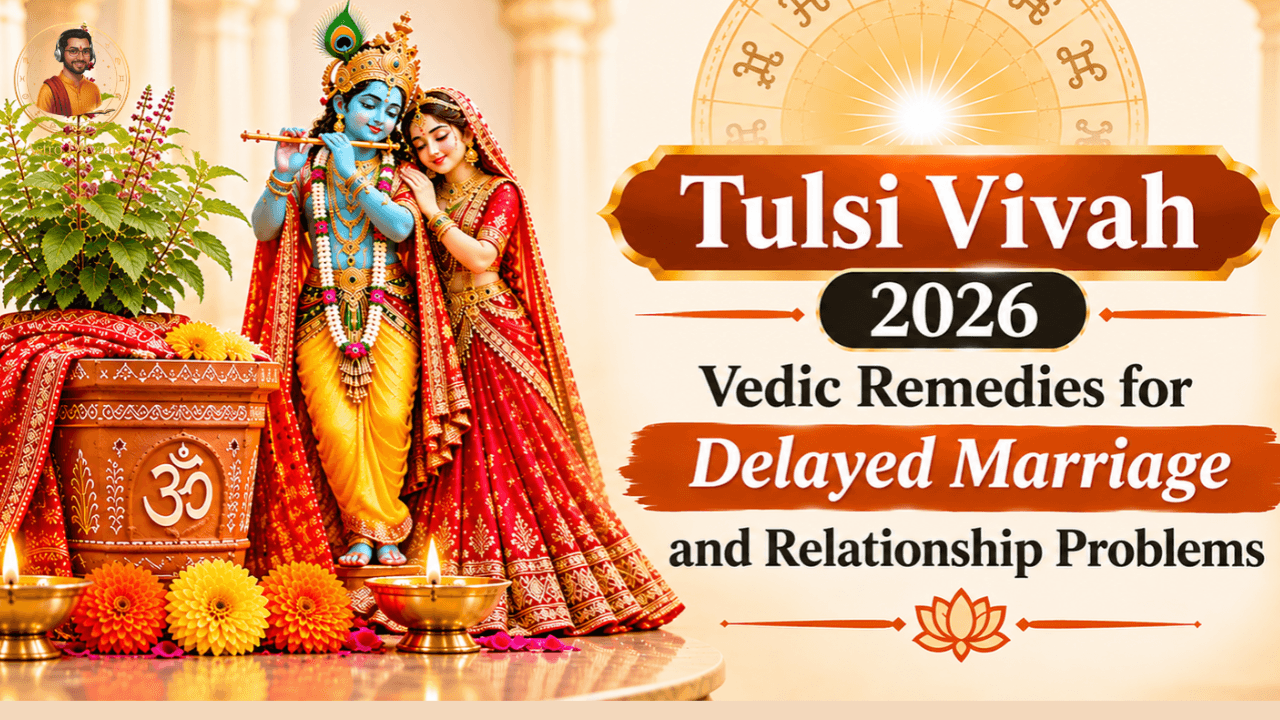
Marriage is an important part of life, but finding the right partner and building a happy relationship does not always happen at the expected time. Some people experience repeated delays in marriage, while others face misunderstandings, family disagreements, emotional distance, or uncertainty in their love life. These situations can become stressful, especially when things do not improve despite sincere efforts.
In Hindu tradition, Tulsi Vivah is considered an auspicious occasion associated with devotion, commitment, harmony, and the beginning of the Hindu wedding season. Devotees believe that worshipping Tulsi Mata and Lord Vishnu with faith can bring positivity, peace, and blessings into family life.
From an astrological perspective, this occasion also offers an opportunity to understand relationship-related concerns through Vedic astrology, planetary positions, and kundli analysis. Traditional remedies performed with devotion are believed to support emotional balance and spiritual well-being.
Let's understand the significance of Tulsi Vivah, its connection with marriage, and some Vedic remedies that people traditionally follow for delayed marriage and relationship difficulties.
When Is Tulsi Vivah in 2026?
Tulsi Vivah in 2026 will be celebrated on Saturday, 21 November 2026, according to the Kartik Shukla Dwadashi tithi. Some regional and family traditions observe the ceremony on Dev Uthani Ekadashi itself, while others follow Dwadashi.
The festival symbolises the ceremonial marriage of Goddess Tulsi, also known as Vrinda, with Lord Vishnu in the form of Shaligram. It is celebrated with traditional wedding rituals, devotional songs, flowers, diyas, and prayers.
For many Hindu families, this occasion marks the beginning of the auspicious wedding season after Chaturmas.
Devotees believe that performing Tulsi Vivah with sincerity brings blessings of happiness, prosperity, and stability into the household.
What Is the Spiritual Significance of Tulsi Vivah?
Tulsi holds a special place in Hindu culture. She is considered sacred and is traditionally associated with Goddess Lakshmi, devotion, purity, and positive energy.
The story of Tulsi Vivah is connected with Goddess Vrinda and Lord Vishnu. According to traditional beliefs, Vrinda's devotion and spiritual strength made her an important figure in Hindu mythology. Her transformation into the sacred Tulsi plant is remembered through this festival.
The marriage of Tulsi with Lord Vishnu represents the union of devotion and divine protection. It also reminds people that a successful relationship requires faith, respect, patience, understanding, and commitment.
From a spiritual point of view, Tulsi Vivah is not simply a religious ceremony. It encourages individuals to bring harmony into their personal relationships and create a peaceful family environment.
This is one reason why unmarried people and couples often participate in the celebrations and pray for happiness and stability in their relationships.
Why Do Some People Experience Delays in Marriage According to Astrology?
Marriage delays can happen for many practical reasons, including career priorities, family responsibilities, financial concerns, personal preferences, and difficulty finding a compatible partner.
In Vedic astrology, however, marriage-related questions are also examined through the birth chart, commonly known as the Janam Kundli.
An astrologer studies several planetary positions and houses to understand traditional astrological indications related to marriage.
Here are some important factors:
1. Seventh House and Marriage Prospects
The seventh house in a birth chart is traditionally associated with marriage, partnerships, and long-term relationships.
Its ruling planet, placement, aspects, and planetary combinations are considered during kundli analysis.
If the seventh house or its lord is influenced by challenging planetary placements, an astrologer may examine whether these combinations indicate delays, relationship challenges, or the need for greater patience.
However, one planetary placement alone cannot determine someone's entire marriage future.
2. Role of Saturn in Marriage Delays
Saturn, also known as Shani, represents discipline, responsibility, patience, and long-term commitment in Vedic astrology.
When Saturn influences the seventh house, its lord, or relevant marriage factors, traditional astrologers may interpret this as an indication of delayed but carefully considered relationships.
Such placements are sometimes associated with individuals who take more time to understand a potential partner or prefer stability over rushing into marriage.
Saturn's influence should not automatically be considered negative. Its traditional lessons include maturity, responsibility, and commitment.
3. Venus and Relationship Harmony
Venus, or Shukra, is associated with love, attraction, romance, comfort, and marital happiness.
Its position in the birth chart is examined to understand relationship preferences and romantic tendencies.
Astrologers also consider Venus's strength, aspects, conjunctions, and relationship with other planets.
A detailed kundli reading can help identify traditional astrological patterns associated with love, compatibility, and emotional satisfaction.
4. Jupiter and Marriage Blessings
Jupiter, known as Guru or Brihaspati, represents wisdom, growth, guidance, and prosperity.
In traditional Vedic astrology, Jupiter is an important planet for marriage-related analysis, particularly in a woman's birth chart, although marriage is assessed through several factors for everyone.
Its placement, strength, and planetary influences may provide additional insight into marriage prospects and relationship expectations.
5. Manglik Dosha and Compatibility
Manglik Dosha is another factor that many families consider before marriage.
It is traditionally assessed through the placement of Mars in specific houses of the birth chart. Some astrologers associate certain Mars placements with disagreements, impatience, or challenges in married life.
However, Manglik Dosha should never be judged through a single placement without checking the complete kundli.
Cancellation combinations, planetary strength, both partners' charts, and other relevant factors must also be considered.
7 Vedic Remedies for Delayed Marriage on Tulsi Vivah
Tulsi Vivah is considered an auspicious occasion for prayers related to marriage, relationships, and family harmony.
According to traditional beliefs, performing certain rituals with devotion can help individuals feel spiritually connected and invite positivity into their lives.
Here are seven commonly followed remedies.
1. Worship Tulsi Mata with Devotion
Worshipping Tulsi Mata is one of the most important rituals associated with Tulsi Vivah.
On this occasion, devotees traditionally decorate the Tulsi plant with a red or yellow chunari, flowers, and traditional ornaments. A diya is lit near the plant, and prayers are offered with sincerity.
Unmarried individuals may pray for a suitable life partner, a peaceful married life, and the ability to build a healthy relationship.
The main purpose of this ritual is to develop faith, patience, and positive intentions.
2. Offer Prayers to Lord Vishnu
Lord Vishnu is worshipped during Tulsi Vivah as the divine groom of Goddess Tulsi.
Devotees can offer flowers, fruits, and yellow-coloured offerings while chanting Vishnu mantras.
One commonly recited mantra is:
"Om Namo Bhagavate Vasudevaya."
Repeating this mantra with concentration is traditionally believed to encourage peace, devotion, and emotional stability.
People seeking marriage blessings may include their sincere wishes in their prayers.
3. Light a Ghee Diya Near the Tulsi Plant
Lighting a ghee diya near the Tulsi plant is a traditional daily practice in many Hindu households.
On Tulsi Vivah, devotees may light a diya during the evening prayers and offer their gratitude to Tulsi Mata.
This simple ritual symbolises hope, positivity, and the removal of negativity from one's surroundings.
Individuals can use this occasion to pray for better communication, understanding, and happiness in their personal lives.
Always follow safe practices while lighting diyas and keep them away from flammable materials.
4. Chant the Vishnu Sahasranama
The Vishnu Sahasranama contains one thousand names of Lord Vishnu and holds an important place in Hindu devotional traditions.
Devotees often recite it to seek divine blessings, peace, and spiritual strength.
If reciting the complete Vishnu Sahasranama is difficult, individuals can begin with a shorter Vishnu mantra and gradually develop a regular prayer routine.
The important thing is consistency and devotion rather than the number of repetitions.
5. Donate Food and Clothes
Charity and helping people in need are important parts of many Hindu religious observances.
On Tulsi Vivah, devotees may donate food, clothes, or essential items to underprivileged people.
Such acts of kindness encourage compassion, gratitude, and a positive attitude towards life.
Rather than expecting an immediate result, consider charity an opportunity to serve others and develop a generous mindset.
6. Offer Yellow Flowers and Fruits to Lord Vishnu
Yellow is traditionally associated with Lord Vishnu and Jupiter in many Hindu practices.
Devotees may offer yellow flowers, bananas, and other fruits during Vishnu worship.
People concerned about marriage delays sometimes perform Guru-related prayers on Thursdays as well.
However, the choice of any specific remedy should ideally depend on individual astrological considerations and family traditions.
7. Pray for the Right Partner Instead of a Quick Marriage
One of the most meaningful prayers during Tulsi Vivah is to seek a compatible life partner rather than simply asking for marriage to happen quickly.
A healthy marriage depends on trust, respect, emotional maturity, shared values, and mutual understanding.
Taking time to find someone compatible is better than entering a relationship under pressure.
Tulsi Vivah can be an opportunity to reflect on the qualities that matter most in a lifelong partnership.
Vedic Remedies for Love and Relationship Problems
Not every relationship problem is connected with marriage delays. Some people are already in relationships but struggle with misunderstandings, communication gaps, trust issues, or family opposition.
Vedic astrology traditionally examines Venus, the Moon, Mars, the fifth house, and the seventh house to understand different aspects of romantic relationships.
Here are some traditional practices associated with relationship harmony.
Worship Goddess Lakshmi and Lord Vishnu Together
Goddess Lakshmi and Lord Vishnu are worshipped together as symbols of prosperity, balance, and harmony.
Couples may offer prayers together and seek blessings for mutual respect and understanding.
This practice can also encourage partners to spend meaningful time together and develop a shared spiritual routine.
Strengthen Emotional Peace Through Moon Worship
The Moon, or Chandra, represents emotions, mental peace, and sensitivity in Vedic astrology.
Some traditional astrological interpretations associate challenging lunar placements with emotional fluctuations or difficulty expressing feelings.
Devotees may pray to Lord Shiva, chant Chandra mantras, or practise meditation to develop calmness.
Alongside spiritual practices, honest communication and emotional support are essential for maintaining a healthy relationship.
Recite the Shiva-Parvati Mantra
Lord Shiva and Goddess Parvati are widely respected as an ideal divine couple in Hindu tradition.
Their relationship is associated with devotion, patience, understanding, and mutual respect.
Unmarried individuals and couples may worship them and recite:
"Om Namah Shivaya."
Regular chanting is traditionally considered a way to develop spiritual discipline and inner peace.
Avoid Decisions During Emotional Stress
Astrology can offer a traditional framework for understanding relationship patterns, but personal decisions should also be guided by communication and practical thinking.
Avoid making major relationship decisions during moments of anger, insecurity, or emotional pressure.
Listen to your partner, understand their concerns, and discuss problems honestly.
No ritual should be used as a replacement for mutual respect, personal boundaries, or professional support when needed.
How Kundli Matching Helps in Marriage Decisions
Kundli matching is a traditional practice used by many Hindu families before marriage.
It involves comparing the birth charts of two individuals to examine compatibility through different astrological factors.
The purpose is not simply to calculate a score but to understand the possible strengths and challenges of a relationship.
Here are some important aspects considered during kundli matching.
1. Ashtakoota Matching
Ashtakoota matching is a traditional compatibility method based on eight different factors.
These factors include Varna, Vashya, Tara, Yoni, Graha Maitri, Gana, Bhakoot, and Nadi.
Each factor represents a different aspect of compatibility according to traditional astrology.
The combined score is commonly calculated out of 36 points.
However, a higher score does not guarantee a successful marriage, and a lower score does not automatically mean that two people cannot build a happy life together.
2. Emotional Compatibility
The Moon sign and Nakshatra are often studied to understand emotional tendencies and mental compatibility.
This can provide traditional insights into how individuals may respond to different situations.
Emotional understanding, however, also develops through conversations, shared experiences, and mutual effort.
3. Manglik Compatibility
Both birth charts are examined to understand Mars-related influences.
An astrologer may also consider cancellation combinations and other planetary factors before making any recommendation.
This helps avoid unnecessary fear based on incomplete information.
4. Long-Term Relationship Stability
The seventh house, seventh lord, Venus, Jupiter, and relevant planetary periods are studied to understand traditional indications related to marriage and partnerships.
A complete analysis may also consider the Navamsa chart, known as the D9 chart.
This gives a broader perspective than relying on one planetary position or compatibility score.
Can Career and Financial Problems Affect Marriage?
Yes. Career and financial concerns can influence marriage decisions in practical ways.
Many individuals delay marriage because they want to become financially independent, establish a stable career, or support their families before taking on additional responsibilities.
In Vedic astrology, career and financial matters are traditionally studied through different houses and planetary combinations.
The tenth house is associated with profession and career, while the second and eleventh houses are connected with wealth, family resources, and financial gains.
Jupiter, Saturn, Mercury, and other planetary influences may also be considered depending on the birth chart.
For example, Saturn's influence may traditionally be associated with gradual career progress, discipline, and responsibility. Mercury is associated with communication, business, and intellectual skills.
If someone is experiencing uncertainty in both career and marriage, a complete kundli analysis may help them understand the different astrological factors involved.
However, astrology should complement practical steps such as career planning, financial management, skill development, and informed decision-making.
Which Zodiac Signs May Focus More on Love and Marriage in 2026?
Every individual experiences planetary transits differently because their complete birth chart is unique.
Still, general zodiac-based astrology can offer interesting themes for self-reflection.
Here are a few signs that may be particularly interested in relationship-related guidance during this period.
Aries: Aries individuals may benefit from patience and thoughtful communication. Avoid rushing into commitments without understanding the other person's expectations.
Taurus: Stability and emotional security may remain important relationship priorities. Focus on building trust and discussing long-term goals.
Gemini: Clear communication can help resolve misunderstandings. Avoid making assumptions when dealing with personal relationships.
Cancer: Emotional security and family relationships may require attention. Try to maintain healthy boundaries while supporting loved ones.
Leo: Mutual respect and appreciation can strengthen romantic connections. Avoid allowing ego to interfere with meaningful conversations.
Virgo: Practical expectations may influence relationship decisions. Allow yourself to understand emotions instead of analysing every situation.
Libra: Balance and partnership are important themes. Give equal importance to your needs and your partner's expectations.
Scorpio: Trust and emotional honesty may become important areas of reflection. Avoid letting past experiences control present relationships.
Sagittarius: Career ambitions and personal relationships may need a balanced approach. Be open about your future plans.
Capricorn: Long-term commitment and responsibility may remain important. Do not put unnecessary pressure on yourself to meet a particular marriage timeline.
Aquarius: Friendship, understanding, and shared interests can support relationship growth. Give relationships enough time to develop naturally.
Pisces: Emotional connection and realistic expectations can help create healthier partnerships. Focus on understanding rather than idealising someone.
These are general zodiac interpretations, not personalised predictions. Individual results depend on the complete birth chart and planetary periods.
Common Mistakes to Avoid While Performing Tulsi Vivah Remedies
Faith and devotion are important, but religious practices should be performed with understanding rather than fear.
Here are some common mistakes to avoid:
Following remedies without understanding: Do not blindly follow every astrological suggestion. Understand its traditional purpose and suitability.
Expecting instant results: Religious rituals are expressions of faith, not guaranteed methods for changing life circumstances overnight.
Ignoring practical relationship issues: Marriage problems also require honest conversations, patience, and mutual effort.
Believing every planetary placement is negative: No planet should be labelled harmful without examining the complete birth chart.
Comparing your marriage timeline with others: Every individual has different circumstances, priorities, and life experiences.
Following expensive remedies under pressure: Avoid anyone who uses fear of planetary positions to demand money for guaranteed results.
Remember that spiritual practices should bring peace and positivity, not anxiety.
Why Personalised Kundli Analysis Matters for Marriage Problems
One of the biggest mistakes people make while searching for astrological remedies is following the same solution as everyone else.
For example, one person may experience marriage delays due to career priorities, while another may struggle with family disagreements or compatibility concerns.
Similarly, two people with the same zodiac sign can have completely different birth charts.
A personalised kundli analysis considers:
▪Date, time, and place of birth.▪Seventh house and its ruling planet.▪Venus and Jupiter placements.▪Mars position and Manglik considerations.▪Fifth house and love-related indications.▪Current Mahadasha and Antardasha.▪Navamsa chart and marriage-related combinations.▪Relevant planetary transits.
By studying these factors together, an astrologer can provide a more detailed traditional interpretation of marriage prospects, relationship patterns, and favourable periods.
It can also help individuals understand whether a suggested remedy is relevant to their particular situation.
Astrology should be used as a source of guidance and reflection, not as a substitute for personal judgement or professional relationship counselling.
Welcome Love, Harmony and New Beginnings This Tulsi Vivah
Tulsi Vivah reminds us that relationships are built on devotion, patience, trust, and understanding. Whether someone is waiting for marriage, facing difficulties in a love relationship, or hoping to create a peaceful family life, this occasion offers a meaningful opportunity to pray and reflect.
Performing traditional Vedic remedies, worshipping Tulsi Mata and Lord Vishnu, chanting mantras, and helping people in need can make the celebration more spiritually meaningful.
At the same time, understanding your birth chart can provide additional traditional insights into marriage-related questions and planetary influences.
Remember that a happy marriage is not only about finding the right time. It is also about finding the right person, developing emotional maturity, and making thoughtful decisions together.
May Tulsi Mata and Lord Vishnu bless your home with peace, happiness, love, and prosperity.
Looking for guidance about marriage delays, love life, or kundli compatibility? Explore personalised astrology guidance with Astro Dhyaan. Connect with experienced astrologers, understand your birth chart, and discover traditional remedies suited to your concerns.
Download the Astro Dhyaan app today and take a positive step towards greater clarity in your personal life. [ Click to Download ]